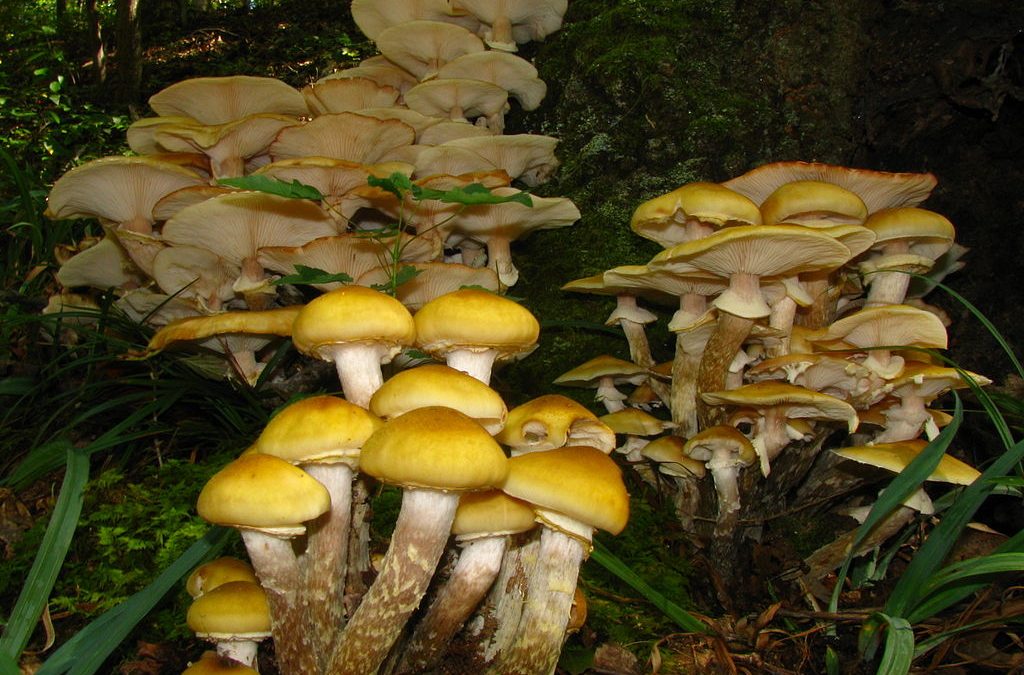

Many gardeners panic when they see mushrooms growing on a tree or tree stump, assuming it is the dreaded Honey Fungus (Armillaria mellea). However, if you are looking in winter, you might actually be seeing the harmless (and technically edible) Velvet Shank (Flammulina). Telling them apart is critical: one kills your garden, the other just helps clean up dead wood.
Unfortunately pruning an apple tree too hard can result in the tree dying and being colonised by fungi.
Exbury Gardens had an outbreak and they can only try to ‘contain’ the spread by the use of airspades, trenching and planting not susceptable plant genera etc.
What can you do? See below. Even after these tests I would still strongly recommend that you consult with a qualified arboricultural consultant to be on the safe side.
How can you differentiate safely between the 2 fungi/mushrooms?
Part 1: The Detective Work (Diagnosis Without Mushrooms)
Even if the mushrooms have rotted away, the “crime scene” evidence remains. Before you start digging, check these three things:
1. The Season Check
-
Autumn (Sept–Nov): High risk of Honey Fungus.
-
Winter (Dec–Feb): High chance of Velvet Shank. (Honey Fungus fruit bodies usually rot away by December).
2. The “Peel Test”
-
Action: Go to the infected stump. Use a knife to carefully peel back the bark at the soil line (the collar).
-
Honey Fungus: You will see a distinct thin, creamy-white sheet of tissue (mycelium) sandwiched between the bark and wood. It often smells strongly of fresh mushrooms.
-
Velvet Shank: You will likely see just brown, wet rot or mushy wood. No distinct white sheet.
3. The “Bootlace” Check
-
Action: Dig slightly into the soil around the roots.
-
Honey Fungus: Look for black, rubbery “wires” (rhizomorphs). They look like bootlaces, are elastic, have a white core, and travel through the soil.
-
Velvet Shank: Does not produce black rhizomorphs in the soil.
But please always remember when you do this you do it at your own risk and you need to disinfect any boots, tools and possible cloths that have come in contact with the fungi itself incl. white sheet or rhizimorphs!
Part 2: Mushroom Identification (If Fungi Are Present)
If you are lucky enough to see the mushrooms, use this comparison table:
| Feature | Honey Fungus (Armillaria mellea) | Velvet Shank (Flammulina) |
| Cap Color | Honey-yellow to brown, dull. | Bright orange/yellow, shiny/slimy. |
| Stem | Often has a ring/skirt near the top. | No ring. Starts yellow, turns velvet-black at the base. |
| Spore Print | White | White |
| Deadly Lookalike | Pholiota (Scalycap) | Funeral Bell (Galerina) – LETHAL |
⚠️ WARNING: Due to the risk of misidentification of the mushrooms do not attempt to eat any of these mushrooms before checking with an expert. Velvet Shank looks terrifyingly similar to the Funeral Bell, which has Rusty Brown spores and causes liver failure.
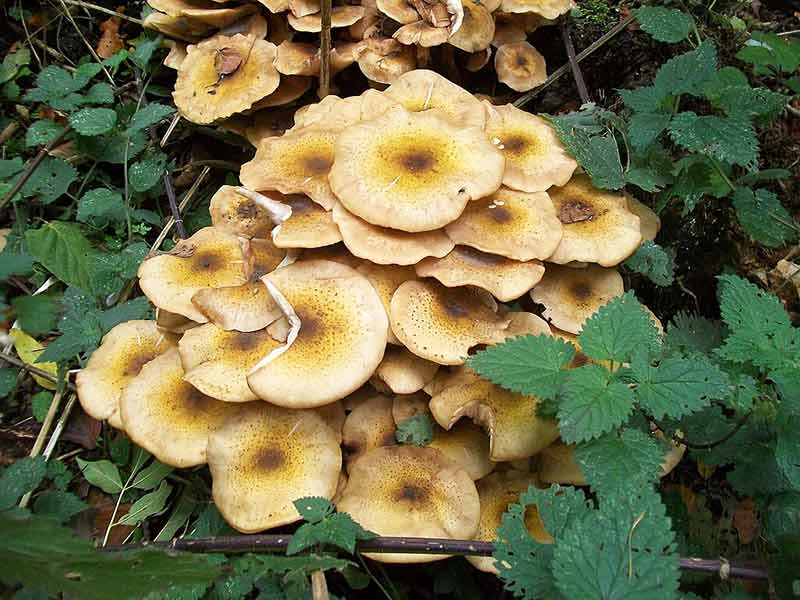
Honey Fungus Armillaria mellea – Source: Wikimedia Commons AnemoneProjectors, CC BY-SA 2.0
versus
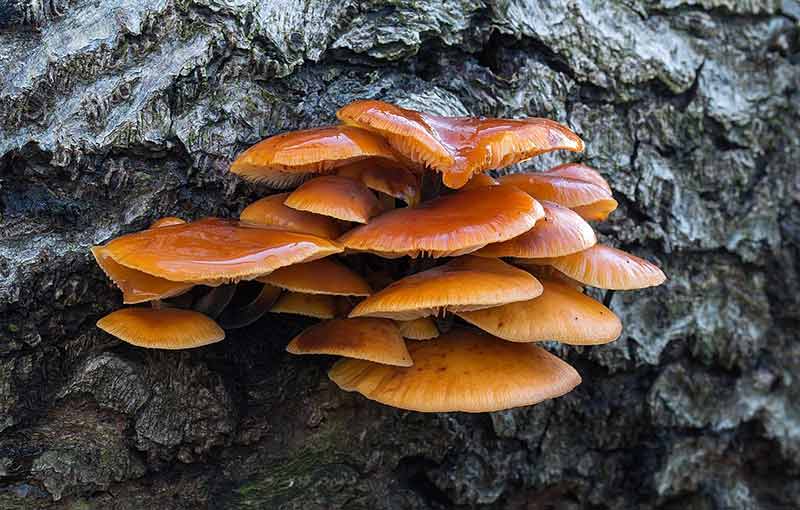
Velvet shank – Flammulina velutipes – Stu’s Images, CC BY-SA 3.0 via Wikimedia Commons
Part 3: The Science Experiment – How to Take a Spore Print
To confirm your mushroom isn’t the deadly Funeral Bell, you must check the spore color. You need to wear gloves and will do this experiment at your own risk!
1.) Cut the stem off a mature mushroom cap (wear gloves!)
2.) Place the cap gills-down on a piece of paper that is half black / half white (or use glass).
3.) Cover with a glass bowl to stop drafts and wait 6–12 hours.
The Results:
White Print: Likely Velvet Shank (Safe-ish).
Rusty Brown Print: Funeral Bell (Deadly).
Part 4: The Action Plan
Scenario A: It IS Honey Fungus
-
The Problem: The stump acts as a “battery” powering the fungus to attack nearby plants via underground runners.
-
The Fix:
1.) Excavate: You must physically dig out the stump and major roots. Let the Professional Arborists / Consultants do this.
2.) Disposal: Burn or landfill the wood. Never compost.
3.) Wait: Leave the soil empty (fallow) for 6–12 months, turning it occasionally to break up strands.
4.) Replant: Choose resistant species like Yew (Taxus), Bamboo, or Mahonia. Avoid Apple, Rose, or Privet.
Note: Chemical “disinfectants” like Jeyes Fluid are ineffective on stumps and illegal for soil treatment.
Scenario B: It IS Velvet Shank
-
The Problem: None. It is a saprophyte (eats dead wood) and poses no threat to healthy plants.
-
The Fix: You can leave the stump for wildlife or remove it if you want the space.
-
Biosecurity: No special boot cleaning is required; it does not travel through soil like Honey Fungus.
Disclaimer: Mushroom identification can be difficult. Disinfect any gloves, tool, cloths and boots thoroughly that have come in contact with the fungi, because the spores and any part can be easily transferred to another private or public garden.
Always get an expert to check what kind of mushroom you got growing in your garden, if you don’t know for sure what it is & don’t eat it. Be very careful!
Specific advice on how to get a professional diagnosis without breaking biosecurity rules.
1. The RHS Postal Service (Members Only)
While you cannot bring samples in person, if you or your friends are members, you can use the RHS Gardening Advice Service via post.
- The Rule: You must double-bag the sample and place it in a sturdy box.
- The Address: RHS Gardening Advice, RHS Garden Wisley, Woking, Surrey, GU23 6QB.
- Cost: Free for members (membership is ~£74/year).
- Verdict: This is still a viable course of action if you join, but it can take time (2-3 weeks) to get results sent to you.
2. The “Gold Standard” Lab: Forest Research
If you want a definitive answer from the UK’s leading tree disease experts (who advise the government), this is where you send it.
- Who they are: The Tree Health Diagnostic and Advisory Service (THDAS) run by Forest Research.
- What they do: They test samples for pests and diseases, including Armillaria (Honey Fungus).
- Cost:
- £40 + VAT for a standard diagnosis (based on symptoms/samples).
- £180 + VAT if they need to culture the fungus in a petri dish (rarely needed for Honey Fungus as the bootlaces are distinct).
- How to do it:
- Go to the Forest Research THDAS website.
-
Download their “Enquiry Form.”
-
Package your sample (root/bark/bootlace) in a sealed polythene bag inside a crush-proof box
-
Post it to their lab at Alice Holt Lodge in Farnham.
3. The “Local Consultant” Option (Site Visit)
Since you can’t drop off samples at a tree surgeon’s yard (they are usually out working), the standard way to get a local expert is to pay for a Consultancy Visit.
You need an Arboricultural Consultant, not just a tree surgeon. A consultant is paid to diagnose, not just to cut.
Local Consultants near Poole:
-
Barrell Tree Consultancy (Ringwood/Poole area)
-
Reputation: One of the most respected consultancy firms in the UK.
-
Service: They offer “Tree Safety & Condition Inspections.”
-
Cost: Likely £300+ for a formal report. This is the “Rolls Royce” option if you need legal proof or a definitive plan for a large estate.
-
-
Mark Hinsley Arboricultural Consultants (Ferndown)
-
Service: Specialists in tree diagnostics and reports.
-
Cost: They will charge an hourly rate or fixed fee for a site visit.
-
My advice is:
Be always very careful when dealing with fungi, investigate careful, desinfect yourself & get professional assistance or best is to call the professionals in when you are concerned and let them investigate and deal with the fungus!
Please checkout also the Horticulture Magazine article on Honey Fungus.